Best Data Science Summer Programs for High School Students
Imagine spending part of your school break working with a real dataset, learning to visualize patterns and explaining your findings to a mentor. A summer program can provide structure and teamwork that ordinary classes may not offer. But the name on the certificate matters far less than whether the instruction, projects, admission rules and cost genuinely suit you.
This guide compares data science summer programs for high school students with a focus on the 2027 cycle. Opportunities range from intensive university academies and medical AI internships to virtual bootcamps, broader pre-college courses and self-directed projects. International eligibility differs sharply, even between programs at the same university.
You will find official links, dates where confirmed, cost comparisons, funding cautions, application guidance and affordable alternatives. No summer school can guarantee a university offer, scholarship or future job. A thoughtful student can also learn substantial data science independently with free tools.
Editorial verification — November 15, 2026: Only official program pages were used for institutional facts. A 2027 date or fee is included only when published for that year. Otherwise, the entry explicitly states that 2027 details are unannounced; consult the linked organizer before applying.
Explore this guide
What counts as a data science summer program?
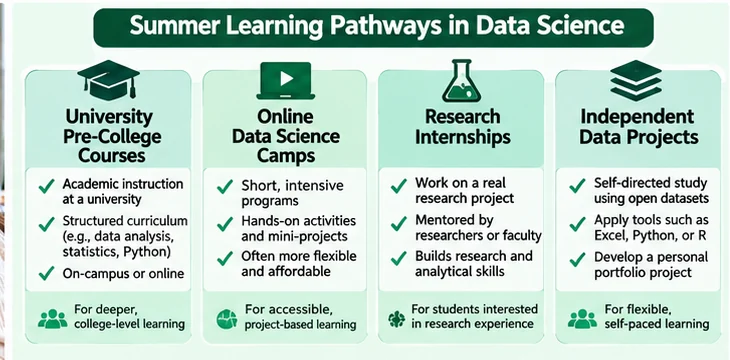
University pre-college courses offer classroom instruction and sometimes credit. Coding camps typically focus on short projects; research internships emphasize mentorship and investigation. Virtual bootcamps use live meetings and assignments, while self-paced courses allow flexible progress but may offer less individual guidance. AI camps overlap with data science, yet can emphasize systems and ethics over statistical investigation.
| Pathway | Typical benefit | Important trade-off |
|---|---|---|
| Pre-college | Structured academic courses | Tuition and prerequisites |
| Bootcamp | Guided exercises | Fixed schedule |
| Research internship | Mentorship and projects | Selective eligibility |
| Self-paced learning | Flexible and affordable | Less direct supervision |
How we selected the programs
We evaluated the relevance of the curriculum, institutional legitimacy, practical projects, eligibility, mentoring, clarity of fees and aid, international access and published application information. This is a curated guide, not a tested ranking or an endorsement obtained from each university. The best option varies with a student’s interests and resources.
Seven summer opportunities to investigate for 2027
1. Wharton Data Science Academy — University of Pennsylvania
Confirmed 2027: June 13–July 3, three weeks, residential in Philadelphia. Wharton lists US$10,999 plus a US$100 application fee. Students graduating in 2028 or 2029, corresponding to current grades 10–11, can apply; international applicants are welcomed. The priority deadline is January 27, 2027 and the final deadline March 19, 2027, both 5 p.m. Eastern Time.
The R-centered curriculum covers statistics, visualization, modeling, machine learning and a capstone. It suits strong mathematics students seeking rigorous project work. Housing and some meals are included; airfare, visa costs and additional meals are not. Scholarships are limited, and international assistance is generally unavailable except specified opportunities such as eligible Caribbean applicants. Official academy · 2027 costs and aid.
2. Stanford AIMI Summer Research Internship
2027 application cycle confirmed: Stanford’s AIMI research internship lists applications opening November 10, 2026 and a February 1, 2027 deadline. This is a two-week virtual, mentored health-AI research experience involving team projects, healthcare data and technical learning; it is not a broad introductory data science course.
Advanced math or programming experience is helpful. 2027 tuition, precise dates and international eligibility should be confirmed directly with AIMI before applying; some older 2026 materials impose US school and residency restrictions and must not be assumed to govern 2027. Students should not confuse this research internship with Stanford’s separate beginner bootcamp. Official AIMI internship.
3. Stanford AIMI Summer Health AI Bootcamp
Confirmed 2027: This two-week virtual program runs June 14–25 or July 12–23, from 9 a.m. to 1 p.m. Pacific Daylight Time on weekdays. Tuition is US$2,500; the standard application fee is US$50. The financial-aid deadline is January 15, 2027 and the standard deadline February 1, both at 11:59 p.m. Pacific Time.
Students entering grades 9–12 in fall 2027 who are at least 14 by the session start can apply internationally. No coding experience is required. Guided projects introduce medical AI; this is not independent clinical research. Need-based aid is restricted to eligible US residents, so overseas applicants should plan without assuming assistance. Official AIMI bootcamp.

4. MIT Beaver Works Summer Institute (BWSI)
2027 details have not yet been confirmed. For reference, MIT’s 2026 BWSI offered technical, project-based courses including AI-related options, with free online prerequisites and some virtual summer classes. The 2026 summer selection was limited to students attending school and residing in the United States, generally rising seniors.
Its 2026 summer fees were waived for qualifying families and US$2,400 for others, without housing. Those figures are not verified 2027 prices. Students overseas may be able to access appropriate online prerequisite learning without qualifying for the summer cohort. Check specific course offerings, age rules and dates at the official BWSI site.
5. Stanford Genetics: Data Ocean / Precision Medicine
2027 cohort details not yet announced. Stanford Genetics lists Data Ocean online learning alongside a four-week Data Science and AI for Precision Medicine high-school camp featuring live sessions, self-paced work, biomedical data and a team capstone. The department also describes self-paced learning, which is not identical to attending a live summer cohort.
Interested students should verify which 2027 version operates, its dates, fees and international rules on Stanford Genetics’ official directory. Do not treat a past summer’s brochure as a current application or mistake its locally restricted GRIPS laboratory internship for this online camp.
6. Harvard Secondary School Program
Confirmed 2027: Harvard’s broader credit-bearing program offers four-week sessions June 14–July 8 and July 12–August 5, or a seven-week session June 21–August 6. Formats include residential, commuter and online depending on course. Costs run US$4,180–US$15,980, plus a US$75 application fee.
Applicants must meet specified age and graduation-year criteria: at least 16 by June 13, 2027, under 19 before July 31, and graduating in 2027–2029. International attendance is possible, but aid generally requires US citizenship, permanent residency or DACA status. Applications open December 1, 2026; the regular deadline is February 10, 2027. Confirm that a particular 2027 course actually covers data science before choosing this general program. Official SSP.
7. University of Oxford AI and Machine Learning Pioneers
Confirmed 2027: Saïd Business School’s residential program in Oxford runs July 18–31 for students aged 15–18 and costs £8,995, including teaching, accommodation, meals and excursions. It accepts applicants from all nationalities and expects approximately B2 English; advanced coding is not required.
The two-week course connects AI with economics, society and responsible decision-making rather than functioning as a purely technical data science camp. Applications use short written responses and a recorded interview with rolling review; a single final cutoff or general scholarship entitlement was not confirmed. Official Oxford program.
2027 summer-program comparison
| Opportunity | Format / level | 2027 dates | 2027 cost | International access |
|---|---|---|---|---|
| Wharton Data Science | US residential; advanced | Jun 13–Jul 3 | US$10,999 | Yes |
| Stanford AIMI research | Virtual; research | Confirm sessions | Not confirmed | Verify |
| Stanford AIMI bootcamp | Virtual; beginner | Jun 14–25 / Jul 12–23 | US$2,500 | Yes |
| MIT BWSI | US/virtual STEM; advanced | Not yet announced | Not announced | 2026 cohort US-based |
| Stanford Data Ocean | Online biomedical | Not yet announced | Not announced | Verify |
| Harvard SSP | College credit; mixed formats | 4 or 7 weeks | US$4,180–15,980 | Yes; aid limited |
| Oxford AI pioneers | UK residential; introductory | Jul 18–31 | £8,995 | Yes |
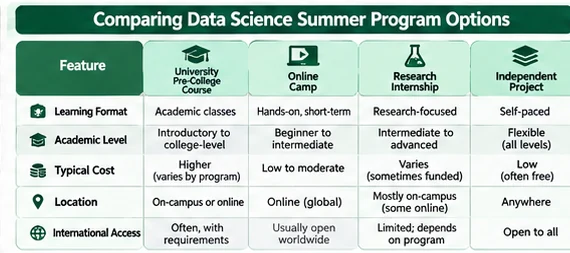
Affordable and free ways to learn
Price is not a measure of how much a student will learn. Alternatives include school STEM clubs, teacher-supervised research using public datasets, free documentation, self-paced tutorials and nonprofit workshops. Google Colab has a no-cost tier with usage limits; Kaggle Learn offers practice resources subject to platform rules.
Distinguish free application, free access to lessons, a paid certificate and a funded internship. A university outreach workshop may be free while travel is not. A self-directed project can culminate in an evidence-based chart, short report and clear reflection. Explore student data science projects or our starting guide instead of assuming premium tuition is necessary.
Optional learning recommendation disclosure: The following course links go directly to providers, without verified affiliate tracking. Participation in university summer programs is not an affiliate product.
Data Science Foundations: Tools, Careers & Real-World Applications
IBM on Coursera · Beginner level. An accessible introduction to data science concepts, professional roles and applications.
Direct provider link; no verified affiliate tracking. Check course age, fees and access requirements.
Scholarships and the true cost of attendance
Financial support may take the form of need-based grants, partial fee awards, application waivers or external sponsorships. Verify whether eligibility covers your nationality and country of residence, and whether the award pays tuition alone or also accommodation, meals, insurance and travel. Harvard SSP limits its published aid eligibility; Wharton’s international exceptions are narrow; Stanford’s 2027 AIMI bootcamp aid is for eligible US residents.
Fictional cost example: tuition US$2,000 + travel US$800 + accommodation US$600 + other expenses US$200 = US$3,600. Your actual total may also include visas, meals, insurance, local transportation, materials and internet. Never submit financial documents to unofficial scholarship intermediaries.

See the Notes for SHS guides on data science scholarships for high school students and international scholarship opportunities for wider funding searches.
Choose the program that fits you
Score academic relevance, eligibility and access, total affordability, project or mentorship quality, and your personal interest from zero to two each. A total of ten is possible. A zero on legal eligibility is a practical disqualification, not something a high score in another category can offset.
| Criterion | 0 points | 1 point | 2 points |
|---|---|---|---|
| Academic fit | Unrelated | Some overlap | Strong relevance |
| Eligibility | Ineligible | Uncertain | Verified eligible |
| Affordability | Beyond means | Aid needed | Within budget |
| Hands-on learning | Unclear | Some practice | Meaningful project |
| Personal interest | Low | Moderate | High |
How to apply: a practical ten-step process
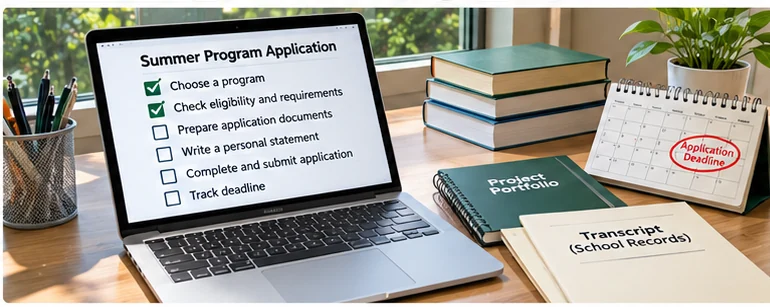
- Verify the exact 2027 program page, eligibility and deadline time zone.
- Review required mathematics, coding and language preparation.
- Prepare genuine transcripts or school reports using secure official channels.
- Write a specific statement explaining your curiosity and learning goals.
- Describe one authentic spreadsheet, coding or classroom project if relevant.
- Ask a teacher for a recommendation only where the program requires one.
- Apply for financial aid separately and meet its earlier deadline when applicable.
- Submit all forms before the posted cutoff and retain confirmation.
- Prepare for interviews or assessments only if specified by the organizer.
- On admission, check safeguarding, payment terms, travel requirements and guardian consent.
Some programs use rolling review, others have fixed deadlines, and some request teacher references or essays. Compare the official checklist instead of assuming every university has identical processes. Use the portfolio guide to describe completed projects clearly.
Example personal statement — fictional student
“In mathematics class, I enjoyed using a spreadsheet to compare rainfall readings and explain a simple graph. That project showed me how a small dataset can raise questions worth investigating. I want to understand how to clean larger datasets, communicate uncertainty and collaborate with learners from different backgrounds. Your program’s guided activities would help me improve my statistical reasoning and introductory programming. I would bring curiosity, patience and a willingness to revise my work when evidence changes.”
This is a fictional example, not a ready-made application. Replace it with your own truthful experiences, verify the required word limit and follow each program’s AI-use and authenticity policy.
Prepare academically and practically
Before the course begins, practise algebra, descriptive statistics, spreadsheet formulas, charts and introductory Python where relevant. Read about data ethics, ask researchable questions and explain a small graph to another learner. Advanced modeling is not compulsory for an introductory camp.
For programming preparation, use Learning Python for Data Science and the beginner tools guide. Keep a calendar for tuition deposits, equipment, travel and sessions.
International applications require extra checks
Universities may define eligibility through citizenship, residence, grade equivalents or the school a student attends. A virtual program that welcomes international learners may still teach during inconvenient overnight hours. Confirm connectivity, accessible software and whether a parent or guardian must consent.
For overseas residential students, verify passports, immigration rules directly with official authorities, insurance, housing, supervision and emergency contacts. Admission does not automatically provide a visa. Compare the real cost in the currency you will pay and be cautious of recruiters demanding unofficial deposits. A school counselor can help interpret the requirements.
What students learn—and what comes next
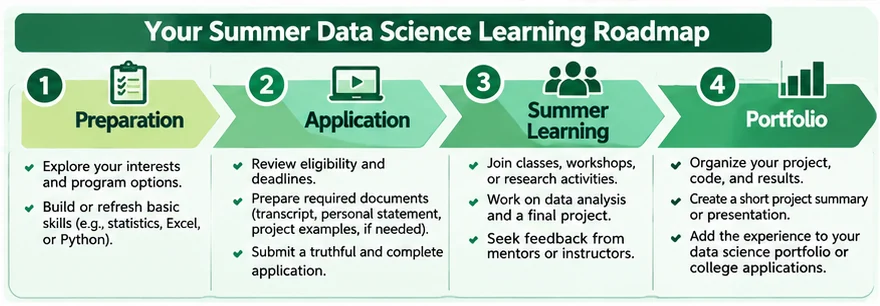
Depending on the program, students may practice R or Python, data cleaning, charts, elementary modeling, ethics, research design, communication or teamwork. Outputs might include a notebook, report, dashboard or group presentation. A certificate documents participation; it does not confer professional expertise or admission to the host university.
Afterward, organize your code and explanations, record what you learned, check whether project data can be shared, and request feedback. Consider an independent follow-up project or the data science degree roadmap. The next step should develop your skills, not merely accumulate credentials.
Introduction to Data Science Specialization
IBM on Coursera · Beginner level. Four beginner courses on data literacy, methods, technical tools and introductory SQL.
Direct provider link; no verified affiliate tracking. Check course age, fees and access requirements.
Eight common summer-program questions
Which summer program is best for a high school student?
Choose by eligibility, academic fit, mentoring and budget. Wharton suits prepared statistics students; Stanford AIMI bootcamp is a virtual introductory health-AI option. There is no universal winner.
Can international students apply to US programs?
Some accept applicants worldwide, including Wharton and Stanford’s 2027 AIMI bootcamp. Others restrict residence or financial aid. Check each official eligibility page.
Are free data science summer programs available?
Some nonprofit initiatives and funded opportunities are free for eligible students, while no-cost tutorials support self-directed summer projects. Verify whether travel and housing are covered.
Must I already know Python?
Not always. Stanford AIMI bootcamp welcomes beginners, while more demanding research or modeling programs may favor strong mathematical and coding preparation.
How expensive are summer programs?
Prices vary from free learning resources to several thousand dollars. Verify 2027 published fees and add travel, housing, meals, visa and other costs.
Can international students receive scholarships?
Possibly, but support is program-specific and often limited. Wharton describes narrow international exceptions; Harvard SSP and Stanford AIMI bootcamp impose eligibility restrictions.
Can students join an online summer program?
Yes. Some Stanford AIMI programs are virtual, and Harvard SSP offers selected online courses. Students should check schedules, devices and time zones.
Will summer school guarantee admission to a university?
No. It can help you learn and reflect on interests, but attendance never guarantees admission, credit transfer, scholarships or a job.
Conclusion: select learning value over prestige
Summer data science learning is not a single kind of experience. A residential university academy, research internship, online bootcamp and independent project provide different forms of instruction and support. The best choice depends on academic preparation, a student’s interests, reliable admission information, budget and whether practical work is included.
For 2027, several institutions have published real dates and fees, while others have not. Treat unknowns as questions for organizers rather than assuming an earlier schedule will repeat. International students should examine eligibility and funding restrictions as carefully as program content. If premium tuition is beyond reach, a supervised project using accessible tools can still develop meaningful analytical skills.
Choose three options from this guide, open their official pages, confirm the newest deadlines and total costs, and prepare one truthful example of what you have learned. That short, evidence-based shortlist is a stronger first step than chasing a prestigious name alone.
Official verification sources
Source pages checked November 15, 2026: Wharton Academy and costs/aid; Stanford AIMI bootcamp; AIMI internship; MIT BWSI; Stanford Genetics; Harvard SSP; Oxford. Details may change after verification.