Generative AI vs. Machine Learning vs. Data Science: What’s the Difference?
Imagine three students working on a school environmental research exhibition. Student A gathers rainfall readings, cleans a spreadsheet, calculates averages, and draws charts showing patterns. Student B trains a small computer model to estimate the next month’s rainfall from earlier measurements and checks how far its predictions missed. Student C asks a generative AI assistant to draft an accessible explanation of their verified results—then checks every number and claim against the original table. Are they working in three completely different fields?
Not quite. These projects illustrate three overlapping approaches: data science focuses on investigating and communicating evidence, machine learning trains models to learn patterns for defined tasks, and generative AI produces content such as text, images, audio, or code. A single project can use all three. The difference lies mainly in the question, method, output, and way the result is evaluated—not in three mutually exclusive industries.
This detailed comparison is designed for high school students and beginners worldwide. You will learn the relationships among AI, machine learning, deep learning and data science; compare tools and career paths; complete an original, code-verified rainfall activity; and practise checking AI-generated explanations rather than accepting them uncritically. The sample environmental records are entirely fictional and are not actual climate measurements.
Quick answer: Data science asks what reliable information can be learned from data. Machine learning trains systems to discover useful patterns for tasks such as prediction or classification. Generative AI specializes in creating content based on learned relationships and provided context. These methods often work together; none automatically replaces the need for human reasoning, reliable evidence or verification.
What is data science?
Data science is an interdisciplinary practice of obtaining, managing, cleaning, analyzing, interpreting, and communicating insights from data. It combines statistical reasoning, mathematics, programming, visualization, domain expertise, and careful study design. Its purpose is not simply to produce large tables or attractive charts, but to answer a question with evidence and explain how much confidence that evidence deserves.
Suppose a student has 48 monthly rainfall figures for a fictional research station. Data science might involve checking that the months are in the right order, verifying measurement units, calculating the overall mean and median, identifying the maximum month, and drawing a chart. The result can be a defensible descriptive report without a neural network or any artificial intelligence system. Human interpretation still determines what the pattern means and what cannot be concluded.
A typical workflow is define a precise question → collect permitted data → clean and inspect → calculate or model → visualize → interpret → communicate. In scientific work, the data source, measurement method, missing records, selection biases, and uncertainty are often more important than the choice of software. A beautifully presented chart from unreliable or invented measurements cannot become a valid climate observation merely because it was produced in Python.

A data scientist might also train predictive models or use generative AI to summarize carefully verified statistics. Those additions do not redefine the whole practice as machine learning. For accessible foundations, read Introduction to Data Science and Your First Data Science Project with Python and Pandas.
What is machine learning?
Machine learning (ML) is a family of computational approaches that fit models from data to perform tasks such as estimating numerical values, classifying observations, finding clusters, or producing other learned outputs. A model is the fitted representation; the learning algorithm is the procedure that adjusts it. Features are relevant input values, and supervised labels are known target outcomes supplied during training. After fitting, the model can make predictions on observations it did not train on.
In our fictional research example, a simple regression model could use the previous month’s rainfall, humidity, temperature, and the calendar season of the month being predicted to estimate the next month’s rainfall. Unlike calculating an average for an already observed table, this requires a model fitted on earlier examples and checked on a separate later period. The estimate is useful only to the extent that the supplied inputs, target, evaluation protocol, and deployment conditions make sense.
Supervised learning learns from labeled input–output examples; unsupervised learning explores structure without a target label supplied for the task. Regression predicts numerical quantities, while classification predicts specified categories. Evaluation varies: numerical error metrics for regression, confusion matrices and class-specific metrics for classification, and more specialized checks for clustering. A training score alone is not evidence that a system will generalize.

Machine learning overlaps with statistics and data science, but it is not identical to either. Statistical methods can describe uncertainty without deploying a predictive model, and data scientists may train machine learning models while doing broader work on research design and communication. For a hands-on supervised example, see How to Build Your First Machine Learning Model Using Python.
What is generative AI?
Generative AI refers to AI systems designed to generate content—such as written explanations, images, speech, computer code, audio, or video—based on learned patterns and the user’s request or other input. Many modern generative systems are built using deep learning. A text-generating model does not retrieve a guaranteed correct sentence for every prompt; it produces an output based on learned statistical relationships and available context.
For example, after Students A and B verify their calculations, Student C might ask a text-generating assistant to explain the findings to a younger student. It may write a fluent summary or suggest better wording, but it could also invent a number, confuse a prediction with an actual observation, or attribute a cause that was never tested. The assistant’s persuasive tone is not evidence that its statements are correct.
Generative AI can support draft writing, translation, image concepts, code scaffolding and study explanations. Yet the fact that output is newly generated does not guarantee factual accuracy, originality, copyright clearance, fairness, or appropriateness for an exam assignment. It can be useful as an assistant to learning, but should not replace understanding the material, checking authoritative references, and following school integrity rules.

AI, machine learning, deep learning and generative AI: their real relationships
Artificial intelligence is the broad research and application area concerned with building systems that perform tasks associated with intelligent behavior. Machine learning is a major set of approaches within AI, and deep learning uses multilayer neural networks within machine learning. Generative AI describes an output-oriented category of AI systems, today commonly implemented using modern neural networks; it is not merely another synonym for deep learning.
Data science is different in kind: it is an interdisciplinary practice that overlaps AI and ML when projects need learned models, but it also includes non-AI activities such as data collection, survey design, statistical estimation, exploratory analysis, and communicating uncertainty. A data scientist may use an LLM to draft a report without training that LLM, or a machine-learning engineer may build a classifier without leading a broader data-science research project.
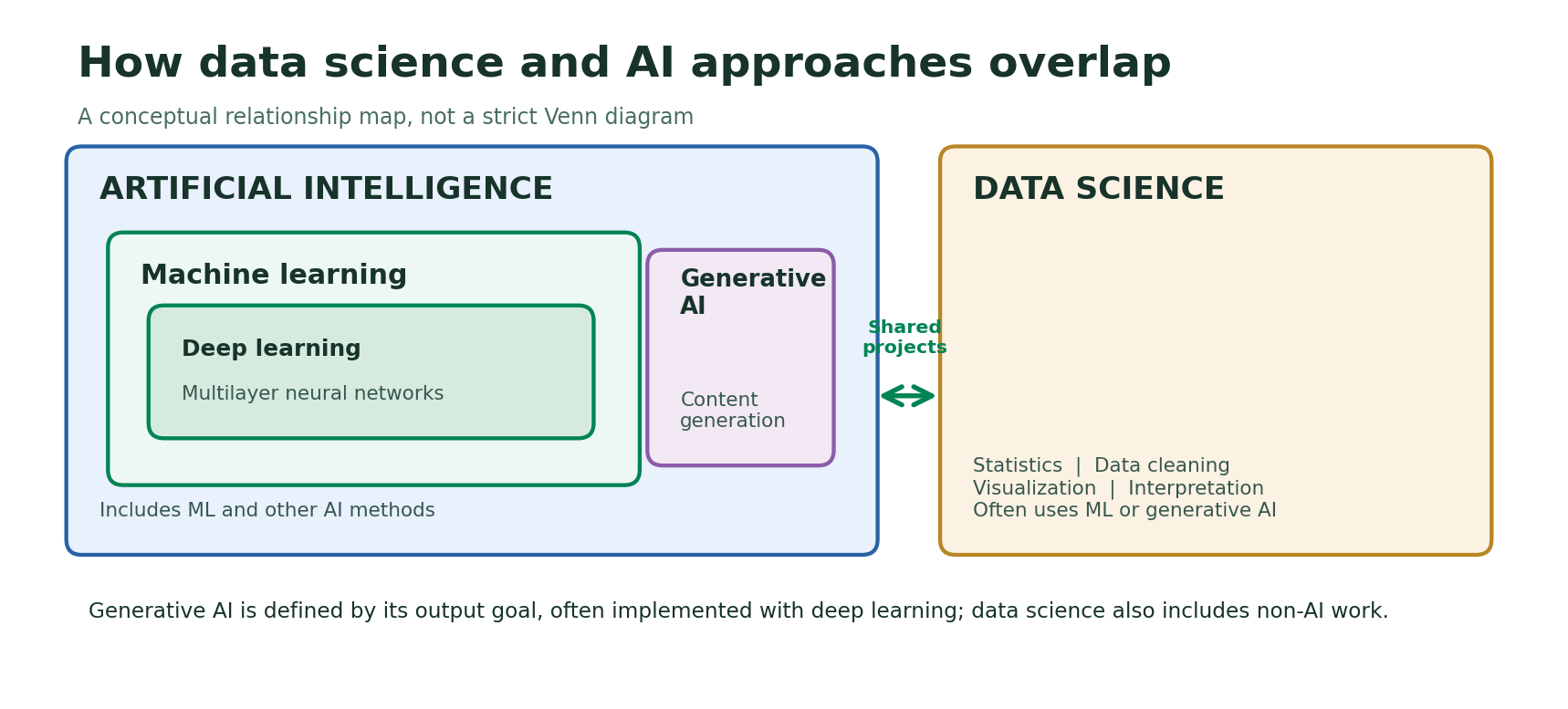
This distinction prevents two common misconceptions. First, not every data science project requires machine learning. Second, not every machine learning system is generative AI: a tree trained to predict a number is still machine learning. If a single project uses descriptive statistics, an ML predictor and a generative assistant, it is a combination of methods rather than evidence that their names are interchangeable.
Generative AI vs. machine learning vs. data science: quick comparison
| Comparison | Data science | Machine learning | Generative AI |
|---|---|---|---|
| Main focus | Investigate and explain data | Learn patterns for tasks | Generate content |
| Typical deliverables | Charts, reports, statistics | Predictions, scores, clusters | Text, images, code, audio |
| Typical methods | Statistics, SQL, plotting, ML | Regression, classification, clustering | Generative modeling, often deep learning |
| Evaluation | Quality of evidence and interpretation | Held-out task performance | Factuality, utility, safety and output quality |
| Student example | Calculate rainfall mean | Estimate a future rainfall value | Draft an explanatory summary |
| Human responsibility | Validate source and conclusions | Validate task, errors and suitability | Check claims, sources and originality |
The table describes typical emphases, not exclusive tools. Data science can contain machine learning; machine learning can include generative modeling; generative AI applications can also perform useful data analysis when given supported tools and inputs. Labels such as ‘AI tool’ tell you less than the actual research objective, available data, intended output and evaluation method.
Predictive AI vs. generative AI: which output is needed?
A predictive task asks for a defined target, such as estimating next month’s rainfall in millimetres or classifying a document into pre-established categories. A generative task asks for new content, such as a readable explanation of the verified statistics, a draft code function or an illustrative image. These are practical distinctions rather than a claim that generative models never predict anything internally: modern language models commonly generate successive tokens using learned predictive distributions.
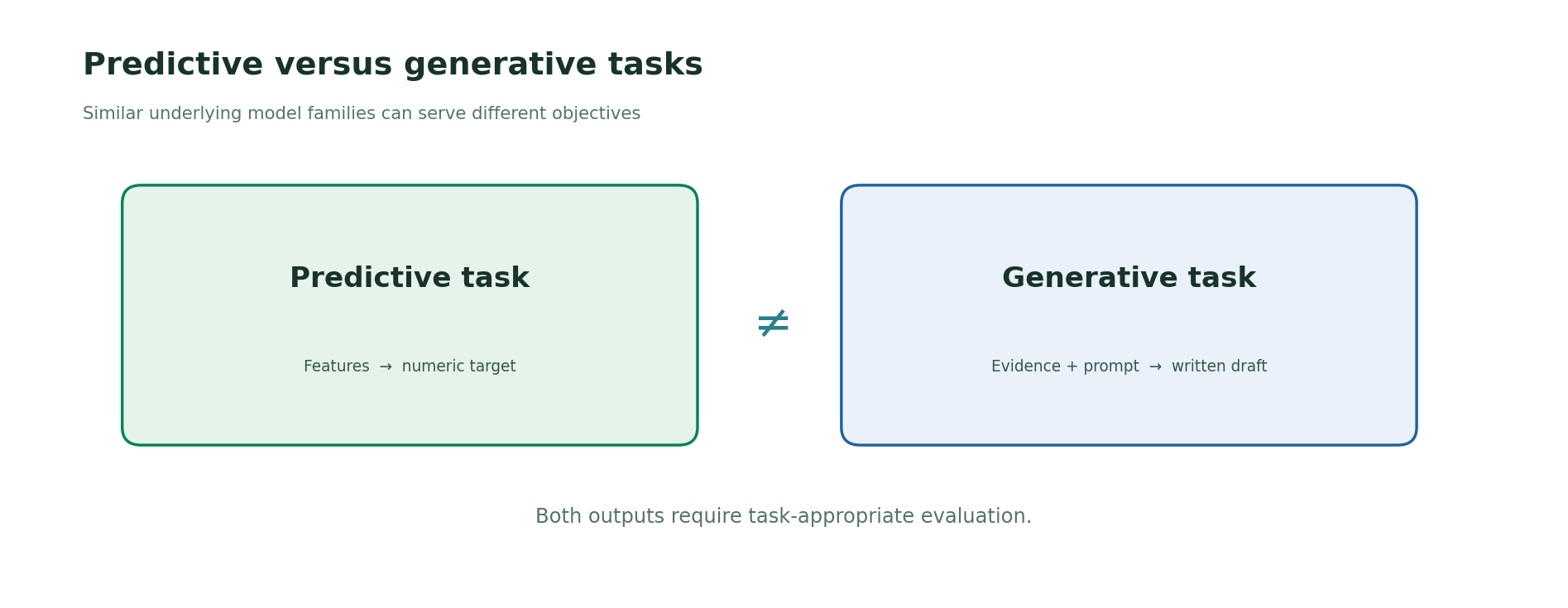
Consider rainfall again. A Ridge regression model outputs a numerical estimate; it can be evaluated by how many millimetres it missed actual held-out values. A generative assistant may produce a paragraph about monthly patterns, but that paragraph should be checked sentence by sentence against recorded statistics. Calling both systems ‘AI’ does not justify measuring a paragraph with the regression’s mean absolute error or declaring a numerical prediction trustworthy because its wording sounds confident.
How data scientists investigate an environmental question
A data scientist begins by deciding what a quantity means. ‘Monthly rainfall’ must have a location, measurement interval, unit and reliable source if the results are intended as real science. In our classroom exercise the records are fictional, and the correct interpretation is limited to the invented table. Even so, it is useful to practise checking dates, ranges and missing entries, computing a mean and median, and distinguishing a description from a prediction.
The scientific process also includes choices about whether to compare monthly values, annual totals or seasonal patterns. A mean can conceal unusually high or low months; a median describes the central ordered observation in a different way. A graph can reveal apparent cycles, but a pattern in simulated data is not evidence about genuine weather. Careful communication includes a source note and an explanation of what the analysis cannot establish.
How a machine learning prediction differs from a statistical summary
A predictive model uses historical examples to fit a relationship between input features and an outcome. In the following example, each input row is built using information from one month, and the target is the rainfall for the following month. The next month’s calendar number is known in advance, while its rainfall is not. This separation avoids an obvious future-information leak. The method uses a chronological training and test split because later-month performance is the question being evaluated.
A Ridge regression model is sufficient for the lesson. It learns linear relationships while penalizing large coefficients, and a StandardScaler helps put numerical input features on comparable scales. We do not claim Ridge is universally best for rainfall, nor does a 48-month synthetic series establish real predictive skill. The baseline and held-out error offer a more meaningful learning exercise than a training score without context.
How generative AI creates language and other content
A modern large language model often breaks text into tokens—pieces of words, characters or symbols represented numerically. It processes the input context, including the prompt and supplied data, through learned parameters. The system then produces successive output tokens using learned probability distributions and its configured generation process. This can yield fluent summaries or useful code suggestions, but a mathematically plausible sequence of tokens does not guarantee a true factual statement.
Generative image systems use different representations and training procedures from text-only LLMs; diffusion-based systems and other generative families can synthesize visual content. Audio and video generation have their own temporal and signal structures. Do not assume all generative models use exactly the same architecture or that an image model is simply a chatbot with pictures. The term ‘generative’ describes the task and output, not one universal implementation.
A user prompt specifies the objective, audience, relevant source material, and output constraints. It may ask an assistant to explain why a chart matters, write a draft caption or identify a missing unit. The assistant should not be treated as an unverified external measurement instrument, and confidential documents should not be pasted into a service without appropriate permission and privacy controls.
What are large language models, and why can they be wrong?
Large language models (LLMs) are neural language systems trained on large collections of text or related materials, typically with substantial parameter counts and extensive compute. They learn patterns useful for predicting and generating language. A context window is the amount of input and relevant prior text the model can consider in a given interaction, subject to its specific limits. The model’s generated explanation should not be mistaken for a direct database lookup or scientific experiment.
A hallucination or confabulation occurs when a generated response contains unsupported or false information. It might invent a weather-station name, an author, a research finding or an exact rainfall value. Even fluent references can be fabricated. The NIST Generative AI Profile emphasizes that generative systems introduce distinctive risks requiring explicit management. Your safeguard is to compare outputs with the original data and reliable citations, not merely ask the model to ‘be accurate.’
Prompt engineering: specific instructions improve usability, not truthfulness
A weak prompt such as ‘Explain statistics’ leaves the intended audience, data, examples and depth unclear. An improved version might say: ‘Explain mean, median and mode to a 15-year-old using five given numerical scores; show the arithmetic, then provide two practice questions with answers.’ That wording makes the goal and success criteria clearer. Still, the user must verify the calculations and any claims about sources.
When working with a table, provide only the relevant non-sensitive values, explicitly identify the dataset as fictional or observed, ask for the units to be preserved, and prohibit invented statistics. If the system is allowed to read web pages or uploaded documents, treat their text as data rather than instructions: untrusted material can include malicious attempts to redirect the assistant. Always preserve control over what information is accessed and what action is taken.
One dataset, three different workflows: complete practical activity
To make the differences concrete, we created one entirely fictional 48-month rainfall dataset covering January 2022 through December 2025. It contains a month, a calendar-month number, rainfall in millimetres, a mean temperature value and a mean humidity value. The numbers were generated deterministically with a fixed random seed to be reproducible. They are invented for classroom practice, not actual records from Ghana or any other location.

Part 1 — Data science: calculate and visualize
First load the supplied CSV using Pandas. Calculate the mean, median, total and extreme monthly values, and create an honest chart from the recorded numbers. Since this stage is descriptive, no model training is needed. A student can reproduce the same process using spreadsheet functions if Python is not yet familiar.
import pandas as pd
import matplotlib.pyplot as plt

df = pd.read_csv('ai-data-science-comparison-sample.csv')
print('Rows:', len(df))
print('Mean rainfall:', round(df.rainfall_mm.mean(), 2))
print('Median rainfall:', round(df.rainfall_mm.median(), 2))
print('Wettest record:', df.loc[df.rainfall_mm.idxmax(), 'month'])
print('Driest record:', df.loc[df.rainfall_mm.idxmin(), 'month'])

plt.figure(figsize=(12, 4))
plt.bar(df['month'], df['rainfall_mm'])
plt.xticks(df['month'].iloc[::6], rotation=30)
plt.ylabel('Fictional rainfall (mm)')
plt.tight_layout()
plt.show()
The tested output contains **48 rows**, a mean rainfall of **115.70 mm**, and a median of **111.95 mm**. The maximum monthly value is **182.6 mm in September 2025**, and the minimum is **57.6 mm in January 2023**. These results are arithmetic summaries of the generated table; they do not support a factual claim about actual rainfall trends, climate change or station performance.

Part 2 — Machine learning: predict a defined target
For an introductory predictive task, use preceding-month measurements to estimate next-month rainfall. The target is created by shifting the rainfall column one month forward. The final row has no future target, leaving 47 usable input–target pairs. We reserve the final 12 pairs for testing and use the first 35 for training. That is a chronological split, not a shuffled test with potential future leakage.
import numpy as np
from sklearn.pipeline import make_pipeline
from sklearn.preprocessing import StandardScaler
from sklearn.linear_model import Ridge
from sklearn.metrics import mean_absolute_error

frame = df.copy()
frame['next_month'] = pd.to_datetime(frame['month']).dt.month.shift(-1)
frame['next_rainfall_mm'] = frame['rainfall_mm'].shift(-1)
frame = frame.dropna().reset_index(drop=True)
frame['next_month_sin'] = np.sin(2*np.pi*frame.next_month/12)
frame['next_month_cos'] = np.cos(2*np.pi*frame.next_month/12)
features = ['rainfall_mm','mean_temp_c','mean_humidity_pct',
            'next_month_sin','next_month_cos']
train, test = frame.iloc[:-12], frame.iloc[-12:]
model = make_pipeline(StandardScaler(), Ridge(alpha=10.0))
model.fit(train[features], train.next_rainfall_mm)
pred = model.predict(test[features])
mae = mean_absolute_error(test.next_rainfall_mm, pred)
base = mean_absolute_error(
    test.next_rainfall_mm,
    np.full(len(test), train.next_rainfall_mm.mean())
)
print('Training/test:', len(train), len(test))
print('Test MAE:', round(mae, 2), 'mm')
print('Baseline MAE:', round(base, 2), 'mm')
Executing the example produced **35 training pairs**, **12 test pairs**, and a held-out mean absolute error (MAE) of **21.46 mm**. Predicting the training-target mean for every test example gave a baseline MAE of **25.90 mm**. The fitted model happened to improve on that simple baseline within this invented sample, but its errors remain substantial and the evidence is insufficient for reliable weather forecasting.
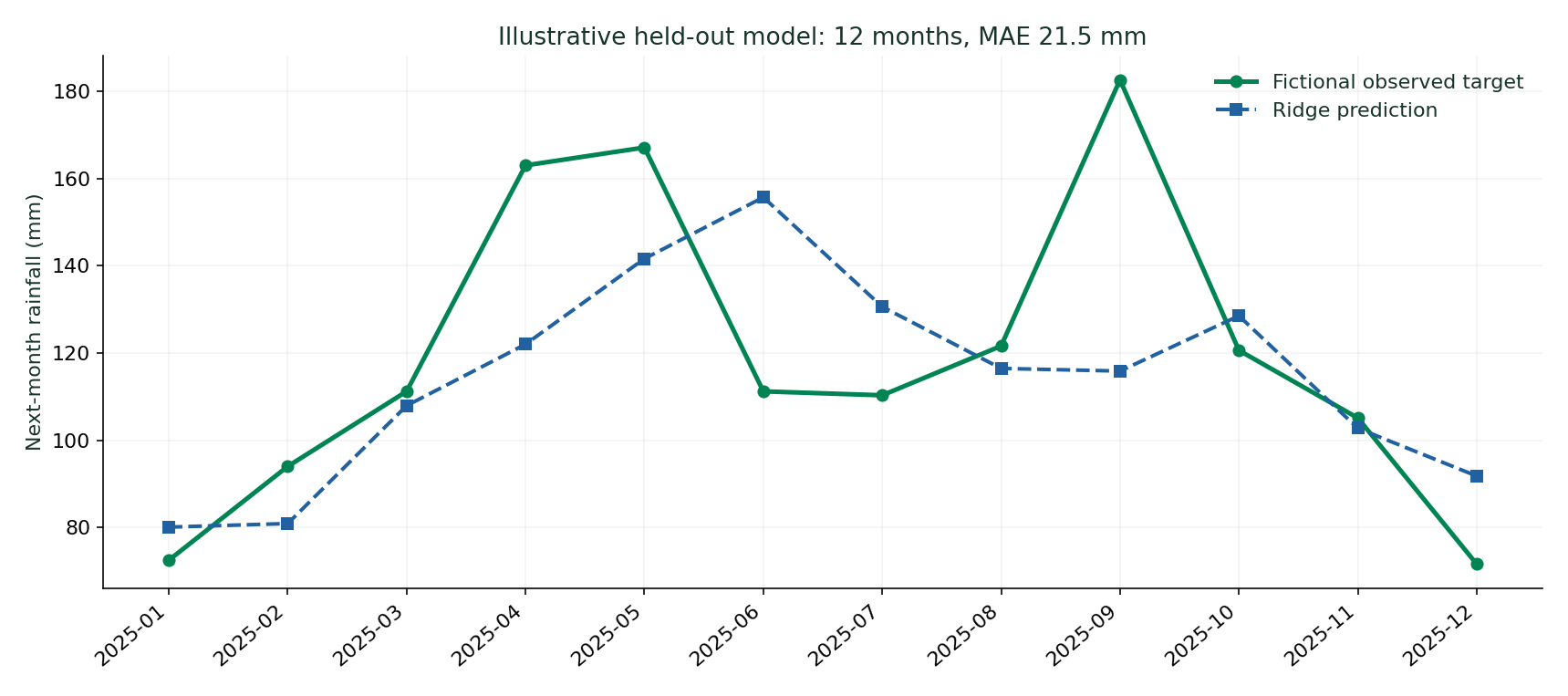
A lower MAE is generally better when the test conditions and task are held constant, because it measures average absolute prediction error in the target’s units. But the number alone says nothing about whether these synthetic relationships exist in the real environment. Twelve held-out months are also a very small test for any broad claim. Do not claim that a generated graph verifies a natural climate pattern or deploy this model as a real forecast.
Part 3 — Generative AI: create a constrained explanation
Now prepare a written prompt for a generative assistant using only the verified summary and evaluation numbers. This stage does not require students to purchase an API key or provide their private records. The following text is an original, reusable prompt template. No external generative AI response was executed or verified as part of this article.
Write a 120-word explanation of a classroom dataset containing 48 entirely fictional monthly rainfall observations. Use only these checked values: mean 115.70 mm, median 111.95 mm, maximum 182.6 mm in September 2025, minimum 57.6 mm in January 2023. A demonstration Ridge model trained on 35 chronological examples and tested on 12 obtained MAE 21.46 mm; a simple baseline obtained 25.90 mm. Clearly state that the records are invented, not real climate data, and that this is not reliable weather forecasting. Do not invent causes, locations, research citations, or extra numbers. Write for secondary school students and finish with one limitation.
A responsible prompt supplies the audience, source values, explicit boundaries, desired output form, and prohibition on unsourced additions. That does not guarantee the model will obey. Even if a generated paragraph repeats the numbers perfectly, it may still make unsupported interpretations about long-term trends or causes; those statements must be removed or independently investigated.
Part 4 — Human validation: check every statement
Create a checklist and compare the draft with the original CSV and model results. Does it say 48 observations rather than 48 years? Does it preserve millimetres? Does it distinguish the mean from the median? Does it correctly describe 21.46 mm as the mean absolute error on 12 synthetic held-out examples rather than an accuracy percentage? Does it explicitly say the data are fictional? Any invented weather station, climate effect, or source needs correction.
This is where the three approaches work together without losing their differences. Data science establishes what the table shows; machine learning demonstrates an evaluated prediction task; generative AI may help communicate the checked findings; and a student remains responsible for the final scientific interpretation. The integrated lesson is not that AI makes human verification unnecessary, but that different tools can support one well-defined evidence workflow.
Everyday applications: three approaches in context
Data science supports educational research, public-health statistics, environmental monitoring, sports analysis, business reporting, financial summaries and scientific experiments. For example, a school may ethically analyze anonymous aggregate exam scores to see which topics need additional teaching. That is an observational question: apparent associations between study time and test scores do not prove which factor caused the outcome.
Machine learning appears in classifying images, filtering spam, identifying patterns in scientific observations, forecasting demand and estimating numerical targets. Each application has a defined outcome and requires appropriate data and evaluation. A fraud-detection alert is not itself proof of misconduct, and a model trained on one population may perform differently on another. The value of a model depends on what a false positive or false negative actually means.
Generative AI helps create study explanations, draft code and captions, translate text, produce illustrative concepts, synthesize audio, and support accessibility workflows. It is valuable for brainstorming or communicating established findings, but output must be checked for accuracy, originality, privacy and licensing. Synthetic training data or generated images should never be passed off as direct evidence from the real world.
Which tools and programming languages are used?
| Data science | Machine learning | Generative AI |
|---|---|---|
| Spreadsheets, SQL, R, Python | Python, scikit-learn, R | Model applications, prompts, APIs |
| Pandas, NumPy, Matplotlib | scikit-learn, PyTorch, Keras | Large language, image and audio models |
| Jupyter, BI tools, dashboards | Evaluation tools, pipelines | Content review and safety tools |
Python is an approachable common foundation across the three areas, but it is not mandatory for every introductory activity. Data scientists may use R for statistical work or SQL to query databases. Pandas organizes tables, NumPy supplies numerical structures and operations, and Matplotlib makes plots. Jupyter Notebook helps combine executable code, figures and explanations. Spreadsheets and business-intelligence applications remain useful for many real projects.
scikit-learn offers established algorithms for classification and regression; PyTorch and TensorFlow/Keras are common deep-learning frameworks. Generative applications can rely on language, image, audio or multimodal models accessed through user interfaces or APIs. An application is not necessarily the model itself: a chat interface may combine a model with tools, retrieval, filters and other software. No single tool stack is universally best.
Which field should students learn first?
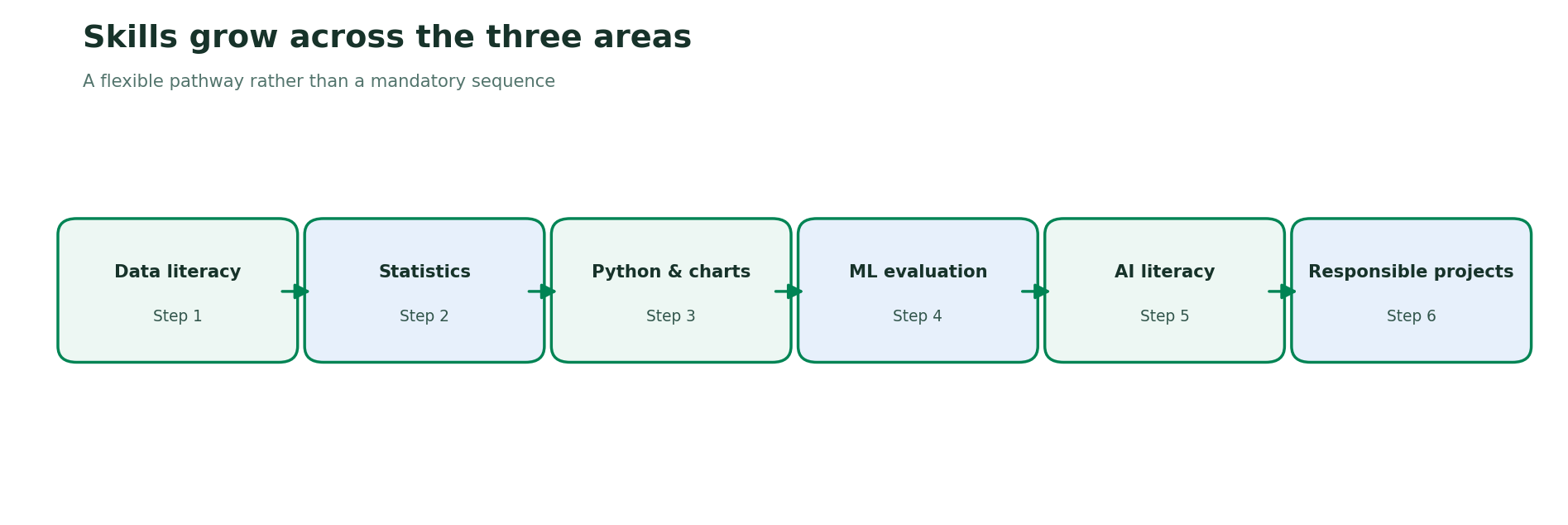
For many students, the most transferable start is to develop data literacy and critical thinking: learn to read tables, calculate averages, interpret charts, ask where data came from and distinguish observation from inference. Basic Python, spreadsheets or another suitable tool then makes analysis reproducible. Once you can explain a dataset and its limits, learning features, labels, training and held-out model evaluation becomes far more meaningful.
You can also explore generative AI responsibly before learning to program. Writing a constrained prompt, examining an explanation critically and checking the answer against a textbook are useful beginner activities. But designing and evaluating machine learning models, especially high-stakes or research systems, requires stronger statistics, algebra, probability, programming and eventually linear algebra or calculus. A good pathway is flexible rather than compulsory.
| If you enjoy… | Suggested starting point | First mini-project |
|---|---|---|
| Charts and numbers | Data science basics | Summarize a public or synthetic table |
| Predicting patterns | Python and supervised ML | Evaluate a small trained classifier |
| Writing and creative technology | Generative AI literacy | Draft then fact-check a study explanation |
| Building products | Programming + data + AI evaluation | Create a tested and documented assistant prototype |
Career paths and transferable skills
Data-focused roles include data analyst, data scientist, research analyst and business-intelligence analyst. Machine-learning roles include ML engineer, applied ML scientist, model evaluation specialist and research assistant. Generative-AI work can appear in AI application development, language-model evaluation, applied research and developer-tool integration. Job titles overlap, and employers often combine data engineering, statistics, software development and human-centered design in one role.
A job title does not guarantee a particular salary or future level of demand, and ‘prompt engineer’ should not be treated as a promised standalone career. Building transferable skills—probability, algebra, communication, debugging, data ethics, information security and experimental design—is more reliable than memorizing product names. Students should aim to show reproducible projects and clear explanations of limitations.
Responsible AI and academic integrity: what can go wrong?
All three areas can mislead when the underlying evidence is poor. A chart can conceal missing records or a misleading axis. A machine-learning model can learn from biased samples or leak target information into its features. A generative assistant can produce plausible but nonexistent citations or confidently repeat false numerical claims. Technical polish does not correct these weaknesses.
Risks include privacy breaches, confidential information exposure, bias, security vulnerabilities, copyright or licensing disputes, misleading synthetic media, automation overreliance, and computational or environmental costs. If an AI assistant reads untrusted webpages or documents, their contents might contain prompt-injection attempts meant to override legitimate instructions. Treat outside content as evidence to assess, not authority to follow.
The NIST AI Risk Management Framework and its Generative AI Profile emphasize systematic risk assessment rather than assuming all outputs are trustworthy. In education, avoid submitting unverified AI-generated text as your own scientific findings. Attribute sources appropriately, understand school rules, and never upload identifiable classmates’ grades or personal details merely to try a model.
Ten misconceptions beginners should correct
- Data science is identical to AI: it includes extensive non-AI analytical and statistical practice.
- Every data science project needs machine learning: careful descriptive analysis may answer the question.
- All machine learning is generative: many models estimate numbers or classify defined categories.
- Every generative AI application is a chatbot: generation includes images, audio, video, code and other formats.
- Fluent AI output is automatically factual: source checking and numerical verification remain essential.
- Correlation proves causation: observed associations alone rarely establish why something occurred.
- Generative AI removes the need for mathematics: technical development and evaluation still demand mathematical skills.
- All AI learns the same way: architectures, objectives and supervision vary significantly.
- No programming is needed in any AI career: application engineering and research typically require coding.
- High overall accuracy guarantees fairness: subgroup performance and real-world harms need separate evaluation.
Ten original student exercises with solutions
Attempt each exercise before opening its answer. When a question involves numerical results, use the fictional CSV or the tested notebook rather than guessing. Explain your reasoning in your own words instead of simply copying the solution.
1. Define data science and describe its main purpose.
Data science obtains, prepares, analyzes and interprets data to answer questions and communicate trustworthy evidence; it need not use ML.
2. Define machine learning and give one example.
Machine learning fits models from data to perform tasks. Our Ridge regression learns from earlier fictional monthly measurements to estimate the next month’s rainfall.
3. Define generative AI and name two outputs.
Generative AI produces content using learned patterns and supplied context. Examples include text explanations and generated images, audio or code.
4. Is a numerical prediction the same as a written explanation?
No. A prediction is evaluated against a known numerical target where available; a written explanation must be checked for accuracy, usefulness and unsupported claims.
5. Classify three examples: a bar chart, a trained spam classifier, a drafted study guide.
The chart is typical data science communication; the trained spam classifier is ML; the drafted study guide is generative AI. A larger project may use all three.
6. How do deep learning and machine learning relate?
Deep learning is a major family of machine learning methods using multilayer neural networks. Not all ML systems use deep learning.
7. What does 115.70 mm represent in our example?
It is the mean of 48 fictional monthly rainfall values, not an observed annual total or evidence from any real weather station.
8. Why should a generative explanation be verified?
It may add invented numbers, false sources, unsupported causal claims or misleading language even when its prose sounds confident.
9. Choose a first skill for someone who likes charts but has never programmed.
Begin with spreadsheet-based data literacy, descriptive statistics and chart interpretation, then learn Python as desired. The pathway is flexible.
10. Design a project combining all three approaches.
For example: use the fictional CSV to calculate checked statistics, fit a small predictor with a chronological held-out set, ask an AI assistant for a constrained explanation, then verify every claim manually.
Four-week beginner learning roadmap
| Week | Core topic | Practical learning outcome |
|---|---|---|
| 1 | Data science foundations | Inspect the fictional CSV; calculate mean and median; make a labeled chart. |
| 2 | Machine learning basics | Define a target and features; train a baseline and examine held-out error. |
| 3 | Generative AI literacy | Write constrained prompts; understand tokens; identify unsupported claims. |
| 4 | Combined investigation | Prepare a checked student report using data analysis, model evaluation and a fact-checked draft. |
This is an introductory schedule, not a guarantee of professional expertise. If you are less comfortable with mathematics or programming, repeat a week as needed. Use the activities to develop transferable reasoning and clear documentation before moving to more complex models or commercial applications.
Download the Topic 58 student learning resources
The printable comparison worksheet (PDF), worked answer guide (PDF), and four-week learning path (PDF) are available in the Notes for SHS media library. The reproducible CSV dataset and executed Jupyter notebook are provided separately as a companion download with the publication report, because this site’s media-upload connection does not support CSV, notebook or ZIP uploads.
Optional Courses: Coursera and Udemy
These courses are optional learning extensions, not prerequisites for completing the free activities. Disclosure: the destination pages were verified as course pages, but no approved affiliate tracking URL was confirmed. The links below are therefore ordinary course links and are not described as affiliate placements. Check current availability, costs and prerequisites directly with each provider.
Generative AI for Everyone
Coursera — An accessible introduction to generative AI concepts, practical uses, prompting and limitations.

Data Science and Generative AI for Beginners
Udemy — A broader course spanning introductory data science, machine learning and generative-AI topics; review its current depth and requirements.
Frequently asked questions
Is generative AI the same as machine learning?
No. Generative AI describes AI systems intended to create content. Many are implemented using machine learning, especially deep learning, but ML also includes non-generative tasks.
Is data science a branch of artificial intelligence?
Not wholly. Data science overlaps with AI but also includes statistics, data management, descriptive analytics and communication without AI.
Can data science exist without machine learning?
Yes. A trustworthy descriptive statistical analysis, chart or experimental report can be data science without fitting a learned predictive model.
What is the difference between predictive and generative AI?
A predictive task estimates a defined target; a generative task creates content. Their methods can overlap, but evaluation should match the intended output.
Are large language models a form of deep learning?
Modern LLMs commonly use deep neural architectures, often transformers, and generate sequences of language tokens.
Can a generative AI assistant analyze data?
Sometimes, especially with appropriate data-analysis tools, but calculations, sources and interpretations still require independent checks.
Which should a beginner study first?
A flexible foundation in data literacy, statistics and critical thinking helps all three fields. Students can also explore safe generative-AI usage before learning to code.
Is Python necessary for every AI task?
No. Python is valuable for technical modeling and analysis, but using a spreadsheet or practicing responsible prompting does not require Python.
Can students explore these approaches for free?
Yes. Public learning materials, permitted synthetic datasets, Python and common open-source libraries support many beginner activities without paid APIs.
Why does generative AI sometimes produce incorrect explanations?
Models generate plausible outputs from learned patterns and context, and may confabulate or misread evidence. Verify all claims against the source material.
Related Notes for SHS articles and authoritative sources
Continue with AI vs Data Science: Key Differences, Examples and Careers and AI and Data Science Collaboration for earlier comparisons. Follow the newer practical series through Machine Learning for High School Students, Supervised vs Unsupervised Learning, Build Your First Machine Learning Model, and Deep Learning Explained. Each destination was checked against the staging WordPress records.
Authoritative background: Google: What is Machine Learning?, IBM: Data Science vs Machine Learning, IBM: Generative AI, NIST AI RMF, scikit-learn, Pandas, and Python documentation. They support the conceptual definitions and reproducible learning approach.
Conclusion: different goals, useful connections
Data science, machine learning and generative AI describe related but different emphases. Data science builds evidence from data and communicates findings; machine learning trains models to learn patterns for tasks; and generative AI creates content using learned representations. They may support one investigation without becoming interchangeable. The right starting point is the problem you are trying to solve, the evidence you can trust and the way you will test success.
In our original classroom project, descriptive statistics summarized 48 invented monthly records, a Ridge model illustrated held-out error on a very small chronological split, and a constrained generative prompt demonstrated how a draft explanation should be checked. None of this established a real-world forecast or justified unverified numerical claims. Reproduce the activities, question your assumptions, document the source of every number, and keep human judgment at the center of educational research.



1 response to “Generative AI vs. Machine Learning vs. Data Science: What’s the Difference?”